What is Concordia?

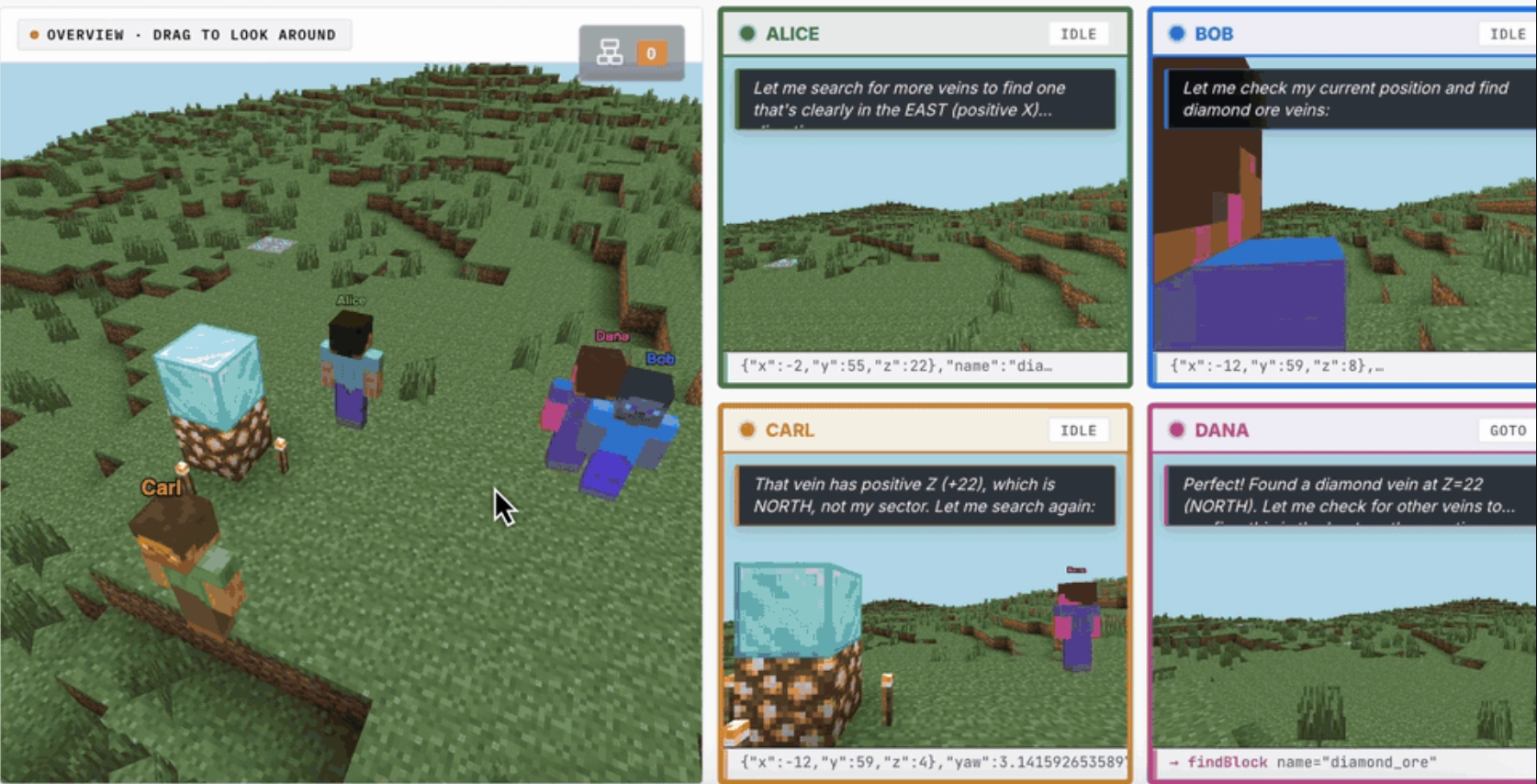
Concordia is an orchestration framework that coordinates four independent, Claude-driven AI agents working together in a shared virtual space. It provides a visual and debuggable interface for multi-agent systems, using Minecraft as the rendering layer while running the underlying communication and coordination protocol inside BrowserPod. The Agentic team was composed of Robert Vassallo.
The project won 3rd Place at the 2026 AI in the Box Hackathon.
What the demo includes
- Emergent Division of Labour: Agents use natural language to divide the map, share inventory states, and cooperate to complete goals (like mining diamonds) without a central orchestrator.
- Human-in-the-Loop Intervention: Users can scan a QR code to manually take control of a single agent via a phone controller while the remaining three agents continue working autonomously around them.
- Observability Interface: A real-time stream showcasing each agent’s current thoughts, tool invocations, active chat messages, and inventory status alongside a live “god-view” map.
How it works
Concordia’s backend and public control plane run entirely inside a BrowserPod Node.js container launched from a single browser tab.
The orchestrator utilizes three basic primitives—team() (read sibling state), chat() (broadcast intent), and deposit() (log results). To connect external controllers (such as a judge’s phone on local venue Wi-Fi), BrowserPod starts an Express server and a WebSocket relay. By leveraging BrowserPod’s outbound port portal, the sandboxed server is exposed via a public HTTPS/WSS link. This network inversion bypasses local NAT and firewalls, allowing external devices to connect securely. The Anthropic Claude API proxy stays server-side inside the BrowserPod container to keep secret keys secure.