What is ForkLab?

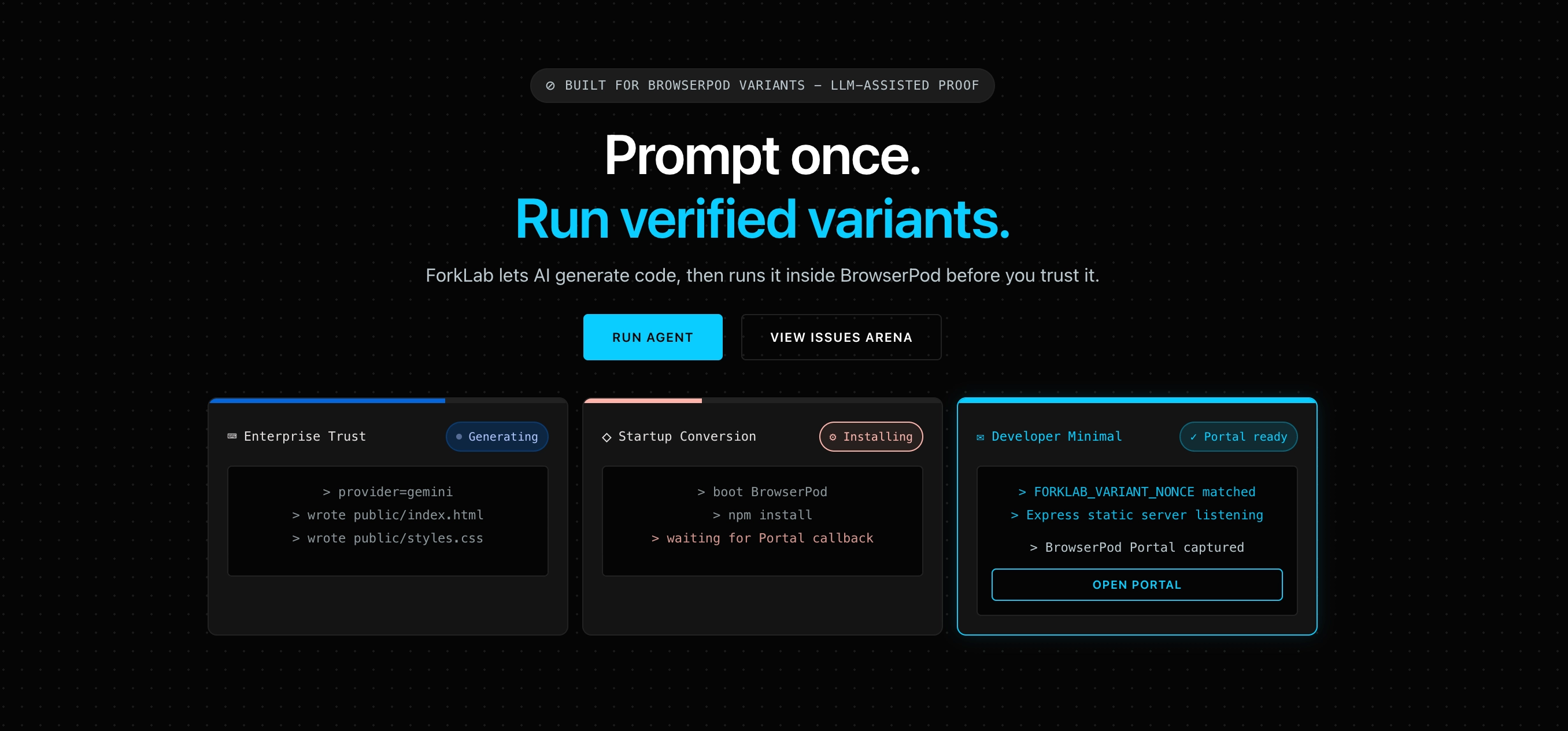
ForkLab is a client-side execution environment designed to bridge the trust gap when using AI coding assistants. It allows developers to safely run, inspect, and verify AI-generated patches and test suites inside isolated, disposable browser containers before adopting the code changes. The Meal Deal team was composed of Sachin Sindhe and Joemugen Kirana.
The project won 2nd Place at the 2026 AI in the Box Hackathon.
What the demo includes
- Command Center (/try): A central dashboard managing prompt templates, task runners, placeholder configurations, and git branches.
- Interactive Sandbox (/sandbox-test): A real-time playground that boots a runtime environment, writes code files, runs execution commands, and streams log outputs.
- Patch Verification Sprint (/sprint): A demonstration of a deterministic bug-fixing loop that loads a CSV export project, executes a failing test suite, applies an AI-generated patch, and reports a passing proof state.
How it works
ForkLab is built as a Next.js application leveraging BrowserPod as its core execution engine.
When a user triggers a code execution task, ForkLab spins up a BrowserPod sandbox completely client-side in the user’s browser tab. Because BrowserPod utilizes WebAssembly to run full server-side runtimes (like Node.js v22), ForkLab can write files directly to the virtual filesystem, install dependencies, run test scripts, and capture standard terminal output. Security headers (COOP/COEP) are configured on the Next.js routes to allow SharedArrayBuffer isolation, keeping the untrusted code entirely sandboxed away from the developer’s local operating system.